About
What is IPBES?
The Intergovernmental Science-Policy Platform on Biodiversity and Ecosystem Services (IPBES) is an independent intergovernmental body established by States to strengthen the science-policy interface for biodiversity and ecosystem services for the conservation and sustainable use of biodiversity, long-term human well-being and sustainable development. It was established in Panama City, on 21 April 2012 by 94 Governments. It is not a United Nations body. However, at the request of the IPBES Plenary and with the authorization of the UNEP Governing Council in 2013, the United Nations Environment Programme (UNEP) provides secretariat services to IPBES. See here for more information on the history of IPBES.
How is IPBES structured?
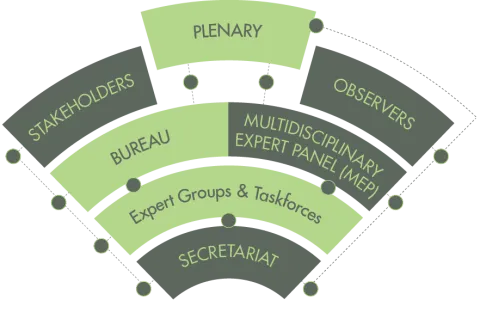
Plenary: The governing body of IPBES – made up of the representatives of IPBES member States – usually meets once per year.
Observers: Any State not yet a member of IPBES; the Convention on Biological Diversity (CBD) and other biodiversity-related conventions; related UN bodies; as well as many other relevant organizations and agencies.
Bureau: Comprising the IPBES Chair, four Vice-Chairs and five additional officers who oversee the administrative functions of IPBES.
Multidisciplinary Expert Panel (MEP): Five expert participants from each of the five UN regions, overseeing all IPBES scientific and technical functions.
Stakeholders: All contributors to and end-users of the IPBES outputs.
Expert Groups & Taskforces: Selected scientists and knowledge holders carrying out the IPBES assessments and other deliverables.
Secretariat (Includes Technical Support Units): Ensures the efficient functioning of IPBES through support to the Plenary, Bureau and MEP, as well as implementing the Platform’s work and administrative functions. Led by the Executive Secretary of IPBES, Dr. Anne Larigauderie. The headquarters of the secretariat is hosted in Bonn by the Federal Government of Germany.

How can you get involved?
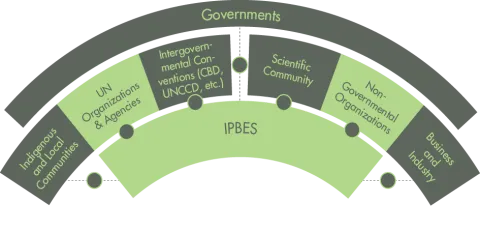
IPBES currently has almost 150 member States. A large number of NGOs, organizations, conventions and civil society groupings also participate in the formal IPBES process as observers, with several thousand individual stakeholders, ranging from scientific experts to representatives of academic and research institutions, local communities and the private sector, contributing to and benefiting from our work.
Why does IPBES matter?
Biodiversity and nature’s benefits to people underpin almost every aspect of human development and are key to the success of the new Sustainable Development Goals. They help to produce food, clean water, regulate climate and even control disease. Yet they are being depleted and degraded faster than at any other point in human history. IPBES is unique – harnessing the best expertise from across all scientific disciplines and knowledge communities – to provide policy-relevant knowledge and to catalyze the implementation of knowledge-based policies at all levels in government, the private sector and civil society.
What does IPBES do?
The work of IPBES can be broadly grouped into four complementary areas:
- Assessments: On specific themes (e.g. “Pollinators, Pollination and Food Production”); methodological issues (e.g. “Scenarios and Modelling); and at both the regional and global levels (e.g. “Global Assessment of Biodiversity and Ecosystem Services”).
- Policy Support: Identifying policy-relevant tools and methodologies, facilitating their use, and catalyzing their further development.
- Building Capacity & Knowledge: Identifying and meeting the priority capacity, knowledge and data needs of our member States, experts and stakeholders.
- Communications & Outreach: Ensuring the widest reach and impact of our work.
What does an IPBES output look like?
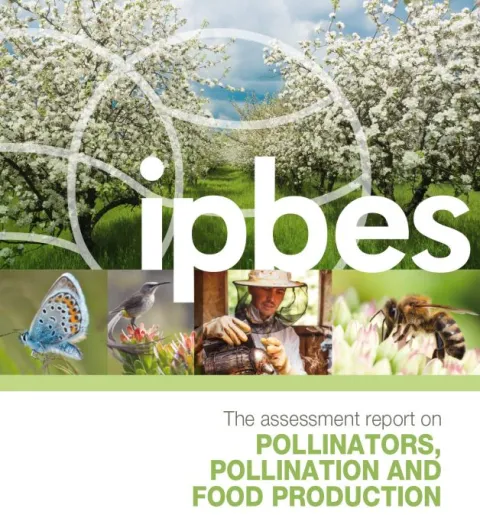
The first IPBES thematic assessment, on Pollinators, Pollination and Food Production, was completed in 2016 – the result of two years of intensive work by 77 experts from all over the world. The assessment cites about 3,000 scientific papers and includes information about practices based on indigenous and local knowledge from more than 60 locations around the world. Its Summary for Policymakers was approved word-by-word by the IPBES Plenary.
Some findings and key messages
Up to $577 billion worth of annual global food production relies on direct contributions by pollinators.
- Agricultural production dependent on animal pollination has increased by 300% over the past 50 years, but pollinator dependent crops show lower growth and stability in yield than crops that do not depend on pollinators.
- Nearly 90% of all wild flowering plants depend to some extent on animal pollination.
- 16% of vertebrate pollinators are threatened with global extinction - increasing to 30 per cent for island species - with a trend towards more extinctions.
- Pesticides, including neonicotinoid insecticides, threaten pollinators worldwide, although the long-term effects are still unknown.
- A range of actions can be taken to safeguard pollinators, from ensuring greater diversity of habitats to promoting sustainable agriculture; supporting traditional practices such as those that manage habitat patchiness and crop rotation; wider education and knowledge-exchange; decreasing exposure of pollinators to pesticides; and improving managed bee husbandry.

There is a wide range of opportunities to engage with IPBES, some of which include:
- Contributing as a nominated expert to our ongoing assessments – as an author, editor or reviewer.
- Supporting our capacity and knowledge-building work by contributing expertise, data or other resources.
- Serving as a regional or subregional communication and outreach partner.
- Coordinating a sectoral or industry-specific network of stakeholders engaging with IPBES.
- Participating in the IPBES Young Fellows programme.
- The first step is to register as an IPBES Stakeholder. It is free and will ensure you receive regular information about the work of IPBES as well as opportunities to get involved. To register go to www.ipbes.net/stakeholders
Intergovernmental Platform for Biodiversity and Ecosystem Services
www.ipbes.net
Email: [email protected]
Tel: +49 228 815 0570
10th floor,
Platz der Vereinten Nationen 1,
D-53113 Bonn, Germany
Follow IPBES:
Twitter: @IPBES
YouTube: youtube.com/ipbeschannel
Facebook: www.facebook.com/ipbes
IPBES is funded through generous voluntary contributions from its member States to the IPBES Trust Fund.